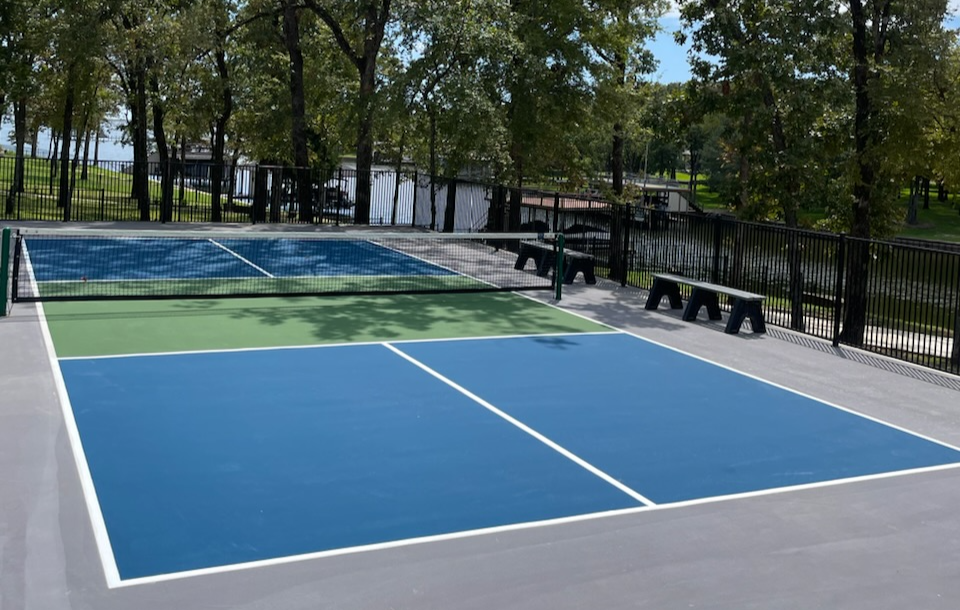
Building a high-quality pickleball, tennis, or basketball court is not just about the surface you see — it’s about the decisions made long before the first coat is applied. This guide outlines the construction standards, sequencing, and technical considerations we follow on every project to ensure consistent performance, durability, and long-term value.
This is not a DIY manual. It’s an inside look at the professional process behind a properly built court.
At SPC OP, LLC, we’ve seen firsthand how small shortcuts during grading, drainage, concrete preparation, and surfacing can quietly reduce a court’s lifespan and play quality. Many of these issues don’t show up immediately — they appear months or years later as cracking, pooling water, surface failure, or inconsistent play.
This guide exists to explain what goes into doing it right — and why experienced planning and execution matter.
Whether you’re a homeowner, school, HOA, or commercial facility, understanding the construction process helps you ask better questions, evaluate proposals more clearly, and avoid costly mistakes. Our goal is transparency — so you know exactly what you’re investing in when you hire a professional court builder.
If you’re considering a new court or resurfacing project, we’re happy to walk you through these steps and how they apply to your site.
Every successful court begins with an honest evaluation of the site. Conditions that appear acceptable for general concrete work may create long-term problems for athletic surfaces.
Key considerations include:
Courts fail more often from unmanaged water than from surface materials. Drainage must be evaluated early, not assumed.
Proper site preparation establishes the conditions the slab will live with for decades.
These layers function as a system. Shortcuts taken here are difficult—or impossible—to correct later.
Concrete for courts must be selected and detailed with surface performance in mind, not just structural adequacy.
Common systems include:
Control joints, when used, must be planned carefully. While joints are common in general concrete construction, they often conflict with acrylic-coated athletic surfaces.
Typical performance-oriented mix characteristics include:
Courts are commonly poured 4–6 inches thick, with 5" min slabs used for post-tension systems or poor soil conditions.
Slope is critical. Courts are generally constructed with approximately 1 inch of fall per 10 feet to promote surface drainage without affecting play.
Surface finish directly affects both playability and coating performance. Courts require tighter tolerances than typical concrete work, and surface texture must be compatible with acrylic coating systems.
Acrylic coating performance depends on the actual surface profile achieved, not solely on how the surface was finished.
Established acrylic sport court systems are designed as layered assemblies and should be applied according to manufacturer guidance.
Commonly used systems include those produced by SportMaster, Acrytech, Laykold, and Plexipave. Performance depends more on surface conditions and preparation than on brand selection alone.
One of the most common causes of court failure is treating court construction like standard concrete work. Driveways and parking lots are designed to carry load. Courts are designed to deliver consistent playability.
Using conventional concrete practices without adjustment often leads to:
A court is a performance surface, not decorative concrete.
This overview is intended for educational purposes and reflects commonly accepted industry guidance, including principles established by organizations such as the U.S. Tennis Court Builders Association. It does not replace engineered plans, professional judgment, or site-specific evaluation.
Well-built courts result from understanding how standards interact with real-world conditions, not from treating construction as a checklist.
For those seeking deeper insight into why courts fail—even when built “to standard”—and how risk accumulates through sequencing, assumptions, and execution, more detailed guidance is available beyond this introductory overview.